Making Your Instagram

A lot of digital marketers have a social media speciality. Mine’s Instagram.

I LOVE INSTAGRAM.

Whether my timeline is filled with my friends looking BOMB in selfies; perfectly curated aesthetic travel bloggers or pictures of my favourite musicians/actors chilling in their widely expensive homes, I just love it!

It does have its downsides though, filters, photoshop and more can contribute to body dysmorphia and there are plenty of trolls out there just waiting to take a good person down.

But here, with me, Instagram is a well of opportunity just waiting to be tapped.

Instagram’s Current Logo as of 20/5/20
Copyright credit to Instagram.

In this blog post, I will be guiding you through how to make an instagram account that best suits what you’re after. Instagram offers many amazing features to customise your account to get the most out of it, with variations such as a business account and a creator account.

Signing Up

First things first, you need to actually sign up to the app!

I recommend signing up with your musician/business email as opposed to your personal one. That way if you receive any emails, they will be sent to the account where you manage your gigs/business.

If you don’t have an email like this, just make one! Its so quick and simple to make new email addresses, it will take you 5 minutes max.

Make sure your password is secure. Some good ideas for making a safe password are:

  • Using both lower and UPPER case
  • Adding at least 1 number
  • Use a special character such as !_-^ etc

If you can’t think of anything, a tip I learnt about is looking at 3 things around you and combining them. For example (and no, this is NOT any of my passwords before you ask) if I combine 3 items near to me, using lower and uppercase letters and using a special character, my super secure password would be Chair_Phone_Desk132. Who on earth would guess that! (Just make sure its something you can remember!)

Username Time

This is hard.

I can spend ages agonising over what my username will be when I join a new website.

But since we’re creating an account for your music/ music-related business, it narrows the name choices down massively.

For example, this blog has an instagram!! It’s @artemis.project.music.blog (give it a follow https://www.instagram.com/the.artemis.project/).

The @ is clearly the name of the blog and tells you what it is. It used to be @the.artemis.project but it was changed to its current @ as there is a board game of the same name, along with a few other variations for other peoples accounts. (But this is the best one 😉 definitely)

Let’s say your name is John Smith, its very likely that someone will already have taken the username @johnsmith or even @johnsmithmusic. If you’re finding it hard to think of a username that is similar to what you want, or is taken, try out these variations:

  • @john_smith_music
  • @john.smith.music
  • @johnsmith_music
  • @johnsmithmusician1
  • @j.smith_music
  • @johnsmith87

You don’t want a username that is too long, otherwise it won’t be memorable!

Changing your account type

Now that you’ve created your unique username and password, it is time to change your account from a personal account to a creator account.

Why should you do this? Because a creator account means you can host ads, look at follower statistics, see when your followers are most active and see your insights for each individual post.

A business account also exists but I personally prefer to use a creator account. If you have a business, check to see if a business account is more suited towards your needs.

To do this, click on the three lines in the right hand corner of your screen. This will bring up a menu. Then click on settings. Find Account (for me, its the third from the bottom) and scroll down. At the bottom of the menu, you should see Switch to Professional Account in blue.

This screen should pop up:
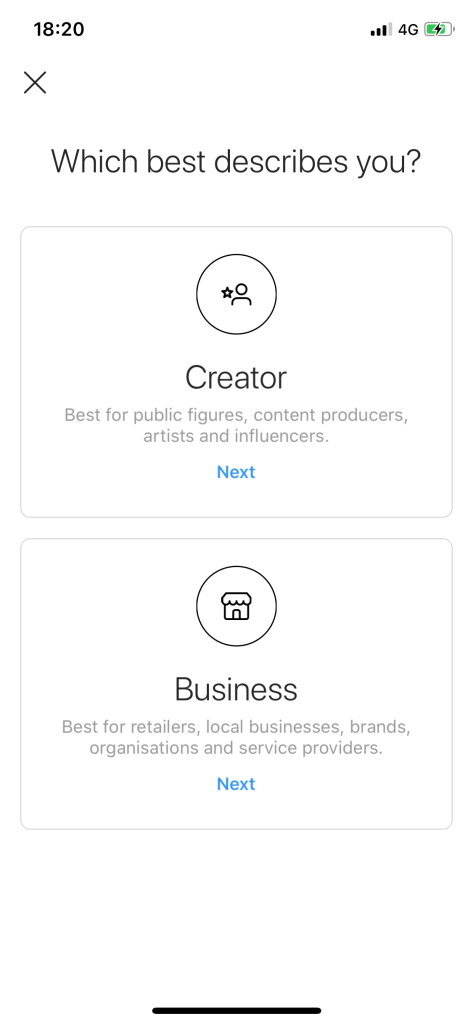
Click on creator and then you’ll find yourself with an option to select your category. This doesn’t change anything about how the app works for you, but it does help to show other people what you are when they click on your profile. Search for one that feels right for you. For @artemis.project.music.blog, I chose Blogger.
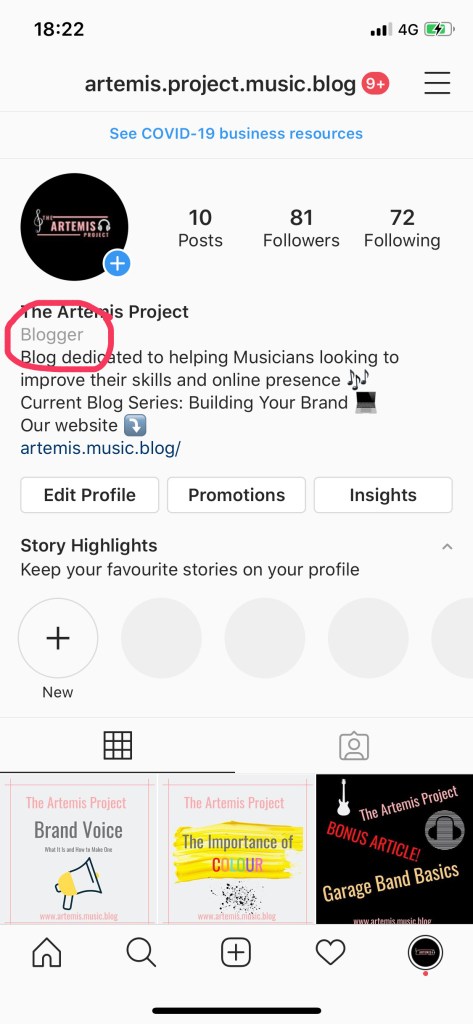
You can choose whether or not you want this to appear on your profile, but why not! If you are a musician, why not have everyone know it when they arrive on your profile.

Now you’re ready to start posting- but WAIT!

Before you start posting, its important to remember your brand voice and target audience that we spoke about in the last blog post.

If you haven’t had a chance to read the Brand Voice blog post- go and check it out before continuing.

Where can you put these things we’ve learnt into action? In the caption!

Captions

Deciding what to write to go under your photos is a tricky business. There are only a few lines that appear before you have to click to ‘see more.’ If you’re writing a shorter caption, it has to contain all the info you want to share in a few short lines button the other hand a longer caption has to be able to draw your follower in to make them want to click to see more.

Doing some competitive research on similar accounts to see how they structure their captions is worthwhile. Also, if you have the opportunity to link to a blog post or video containing more information, you can keep the caption short whilst directing readers to the link in your bio.

Aesthetic

When you click on someones feed, if it isn’t visually appealing, its much less likely that you’ll want to follow them unless it’s someone you already know.

Don’t get me wrong, its super hard to create a consistent and attractive looking feed. As well as working on this website and the instagram that goes with it, I have been running a travel blog for a year and a half and still hugely struggle!

Although she isn’ a musician, check out @girlwiththeredbob. Now I’m not saying your feed has to look anything like this or even be consistent in colour, but when it comes to aesthetic feeds, this girl is a queen.
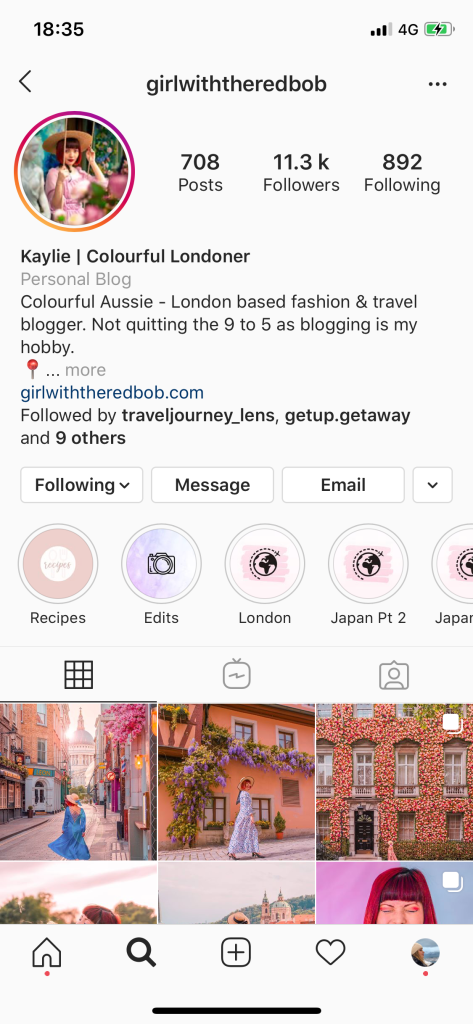
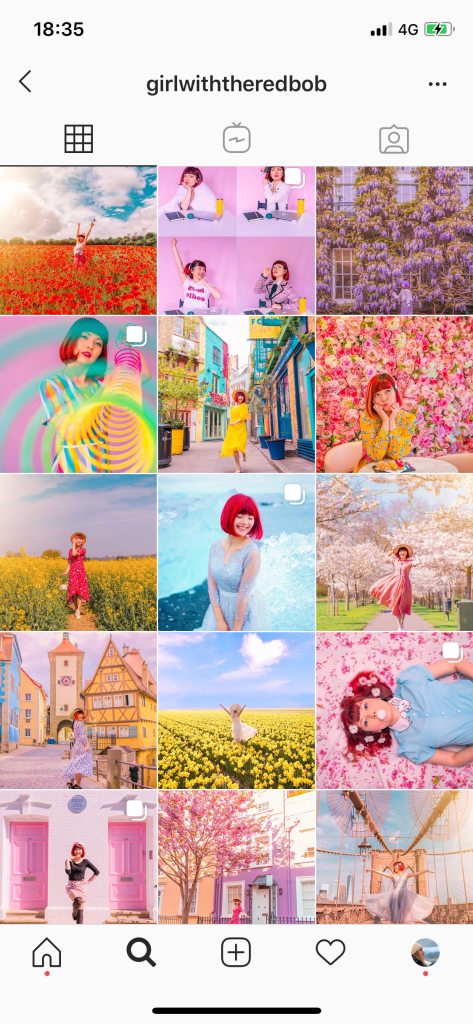
A quick tip to remaining consistent even when your photos look nothing alike is to have consistent brightness. If you have a mix of light and dark based photos, post all the light ones together and let them lead into the dark ones- it is far more pleasing to the eye than a jumble!

Got all these down? Now it’s time to get posting!!

Keep your eyes out for the next post where we will talk about Hashtagging, using your analytics and more.

Thanks!
Brand Voice: What it is and How to Make One

Before we can create our social media pages, there are a few things to that we need to consider first.

First of all we need to decide on our brand voice.

So… what is a Brand Voice?

A brand voice is how you want to sound to your audience. The way you word your captions, posts and even the way you speak in videos is your brand voice.

If you want your target audience to relate to your content, it is important that you can communicate with them in a way that reflects their personality.

Not sure what your brand voice should be?

Here are a 5 handy steps to figure it out:

Image from Unsplash

1. Figure out what you will be posting

Are you an acoustic singer songwriter, a DnB DJ or a professional wedding band looking for work?

Your tone of voice can change how people perceive you. A Wedding Band, aiming to present themselves as professional and reliable musicians, would post pictures of themselves performing at events or photos of them in a studio session. The language they would use would be different from an upcoming DJ, who would want to relate to fans who are a part of DnB culture. Their posts may be short samples of their work, shots of their setup or photos of them performing in venues very different to that of the wedding band.

2. Who are your target audience?

For some, this can be more difficult to define as music is listened to by all sorts of people!

An example of this would be, if you are a late teens-twenties male solo pop singer, by looking at the fanbases of people like Harry Styles and Shawn Mendes, you can guess that your target audience would be majority female and mainly from the age bracket of 13-30.

When Harry met Dorothy. While she isn’t in his most common age brackets, when my parents and grandma went for lunch (without me- cri) they ran into Harry and he took a photo with her! He’s such a gent ❤
My family now stands Harry forever.

But how do you figure out your target audience?

Before creating social media pages, it is understandable that you’re only going to be able to create an approximate range. Once you’ve been on social media for a while and have access to statistics and measurements (which we will talk about in a later blog post) you can narrow it down.

But to start off, look at the fanbases of other artist that are within your genre. It’s likely that they will share that target audience with you.

If you’re selling a music product, research who the type of people are who would buy your product, or something similar.

There are a few things to consider when defining your target audience. These are a few examples: Age, Sex, Location and Interests.

One thing that will make it easier for you is to start where you are. If you’re a pianist in Singapore, there’s no use marketing yourself to people in Croatia! Once you have built a fanbase where you live, then it is time to think about expanding.

3. Describe Your Ideal Follower

Who do you want to reach?

Create a table or graphic that describes your ideal fan/customer.

For example, I want to start creating electro pop music and would like to appeal to people in their twenties or late teens. I feel like the music I want to make would resonate more with people identifying as female who like a mixture of classic pop but with electronic influences. They would live in the UK, and whilst I am only just starting out, they would live in the North of the UK because if I were to perform, I’d like it to be somewhere nearby.

What would your description be? Comment yours at the end of the article!

4. Brand Voice Chart

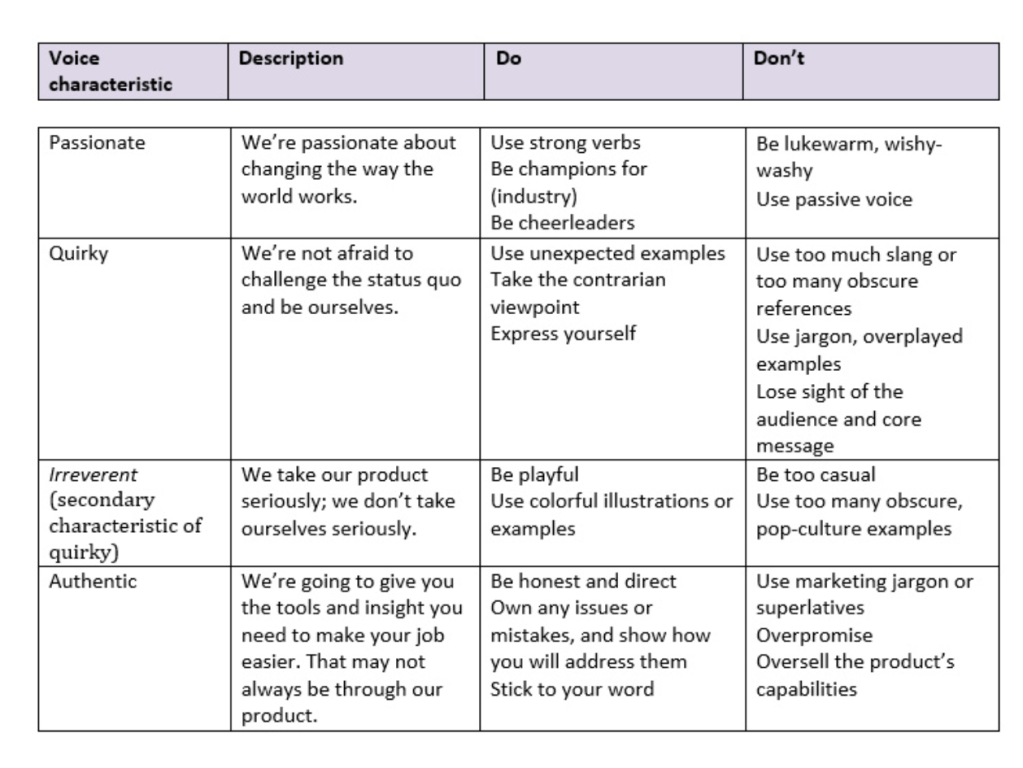
The Content Marketing Institute talk about creating a Brand Voice Chart.

(Link to the original article- https://contentmarketinginstitute.com/2015/10/define-brand-voice/)

Taken from The Content Marketing Institute Website

It is helpful to decide on your tone of voice.

When planning how I wanted to write these blogs, I decided I wanted to be professional and authentic (I hope I’ve achieved this!) as I want to share accurate information with you guys, but not be stuffy about it! Adding a bit of personal flair to let you know I’m a person, researching and sharing all these experiences alongside you is how I try to add authenticity.

Creating one of these charts is helpful to make sure you stay on brand when writing. In the far left column, write 3 words that could be used to describe how you want your brand voice to be.

Then, following the chart above, write a description of how the word would be used with your brand.

5. Keep On Top of it!

Once you’ve made your social media pages and have been on them for a while, you should have access to a bunch of cool statistics that tell you the Age, Sex, Location and Interests of the people who follow you. If you’ve been targeting females in their thirties but it turns out the people who interact with you the most are males in their twenties, change it up! You are never stuck with anything when it comes to social media.

So there you go! There are 5 handy tips to help you create and keep on top of your brand voice.

Did you find this article helpful? Subscribe for more like this!

Thanks!
The Importance of Colour: Creating an Brand

Hey everyone!

In these next few blog posts we are going to be covering all sorts to things to help you build your brand as a musician/ music business, create and online presence and keep your fans interested in what you have to say.

Starting with the basics: Colour

Want to build a website or create a consistent looking instagram feed? Colour is the first thing you should be thinking of. This doesn’t just apply to your online life, but also to things such as your album art and outfits. For example, if you’re from a hard-rock band, creating album art with pastel pinks and bright yellows might send confusing messages to fans.

Whether you want to plan your performance outfits, create a header for a facebook event, or even start your own music blog, I have researched the meanings behind colours so that you can use this post as a guide!

Red

Red can be linked with things such as anger, hate, and war whilst also being associated with cupid, passion, and love.

It has been shown to be able to have a physical effect on people, raising respiration rates and even blood pressure.

Orange

Unlike red, orange can be less overpowering but still have a warming effect.

It is associated with health and vitality (because of the fruit) and is seen as vibrant and inviting.

Yellow

Yellow can invoke feelings of happiness and cheerfulness. In decoration it can often be quite overpowering so use with care!

Green

Green is associated as earthy and can symbolise growth and abundance. Due to its relation to nature it can often have a calming effect.

For Blues, the association often depends on the shade:

Light Blue

Light Blue can have a calming effect and can be relaxing to look at. It can come across friendly and inviting to look at.

Bright Blue

Bright blues can invoke a feeling of excitement and can often be energising.

Dark Blue

Dark blues can create a feeling of strength and even professionalism.

They can also invoke feelings of loneliness, or even make you think about the ocean or the night sky.

Light Purple

Light purples such as lavender can be seen as romantic, showcasing feminine energy and delicateness.

Dark purples are associated with royalty and high society. Due to this, it can also indicate wealth.

Pink

Pink can invoke feelings of fun, harmony and friendship.

It is stereotypically associated with femininity, especially during youth.

Beige

Neutral, calming and extremely versatile, beige can be used as both a background or to accent other, more vibrant colours.

Grey

Professionalism and formality are what grey brings to the table. It is often used on business websites.

Black

When used in abundance is often associated with edgier designs.

When used amongst others, is can show elegance and formality– especially when it is used for important text. On the other hand, it is also associated with death and mystery.

White

White can be associated with purity, virginity and cleanliness. It is also a key colour in bridal and the health industry.

Choosing Your Colours

When its time to choose which colour to associate with your brand as a musician/ music business, try to keep these associations in mind. First impressions are made quickly so the colours you choose will stick in a viewers head. I chose black and pink for the accents of this website because I enjoy the elegance of black and want to spread some fun with the pink!

Did you find this guide useful? Let me know down in the comments!

Thanks! x

Garage Band Basics

Surprise!!

I have a bonus songwriting article for you, but this time it’s a little different. Now that we’ve covered the building blocks of lyric writing, I’ll be going through how to create a basic backing track on Garage Band.

If you’re not an apple user, I’m sorry but you wont have access to this software, however I hope some of the steps could be transferable to other pieces of software such as Logic or ProTools.

The Recording Sequence

  1. If you’re planning on recording anything live, that should be number 1 on your list. Garage Band has a handy metronome option which you can set to whatever tempo you like to record along too. (Fun tip: You can turn the metronome on and off with command and U)

If you’re adding MIDI tracks, this would also be the time to do so.

2. Editing and Overdubbing comes next. Listen to your recordings with a citric; ear. Finding any bits you’re not happy with. Here is when you can get rid of any annoyingly loud breaths, re-record a couple of lines that sound off or even get rid of any unwanted background noise.

3. Time to Mix! This is the time to start using plug ins such as EQ (equalisation), Compression and Automation (volume control)

4. Finally, its time to Master the track. This means editing everything at once to create the final object.

Image from Unsplash

Using MIDI

MIDI stands for Musical Instrument Digital Interface. Essentially, there are tons of digital; instruments available for people to use no matter where you are.

The easiest way to access these instruments is to download the ones Garage Band comes with and to connect a MIDI Keyboard. You can get them on Amazon and don’t even have to spend a fortune!! The one I have bought only cost around £25!

Once plugged in to your laptop or computer, you now have access to hundreds, if not thousands or computer generated sounds. Using a MIDI keyboard doesn’t mean you can only play piano sounds, nor do you need to be skilled in actually playing the piano to work this (honestly my piano playing suuuuckkkssss.

Each key will correspond to either a note, or sound of whichever instrument you choose. Lets say you choose to play a midi drum kit, one key will represent a cymbal, the other the snare drum etc.

Image from Unsplash

Loops Loops Loops Loops Loo-

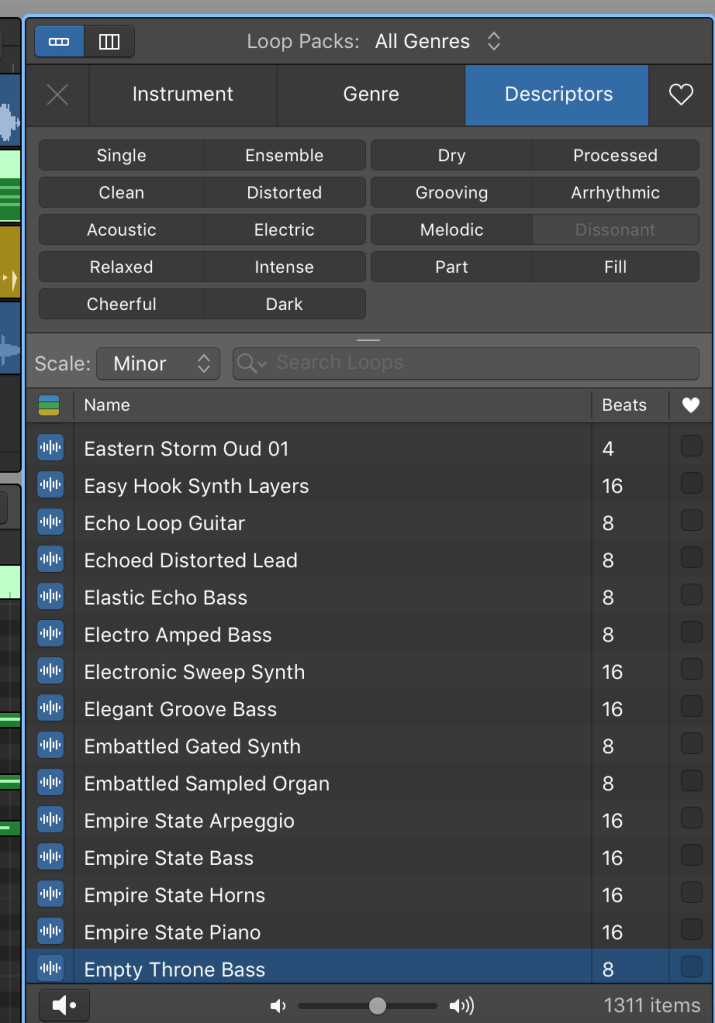
In garage band, you have access to a large collection of loops of all kinds. You can access these all in the loop browser. There are things such as rhythmic drum kits, bass guitars, synths, Dance-type beats and more.

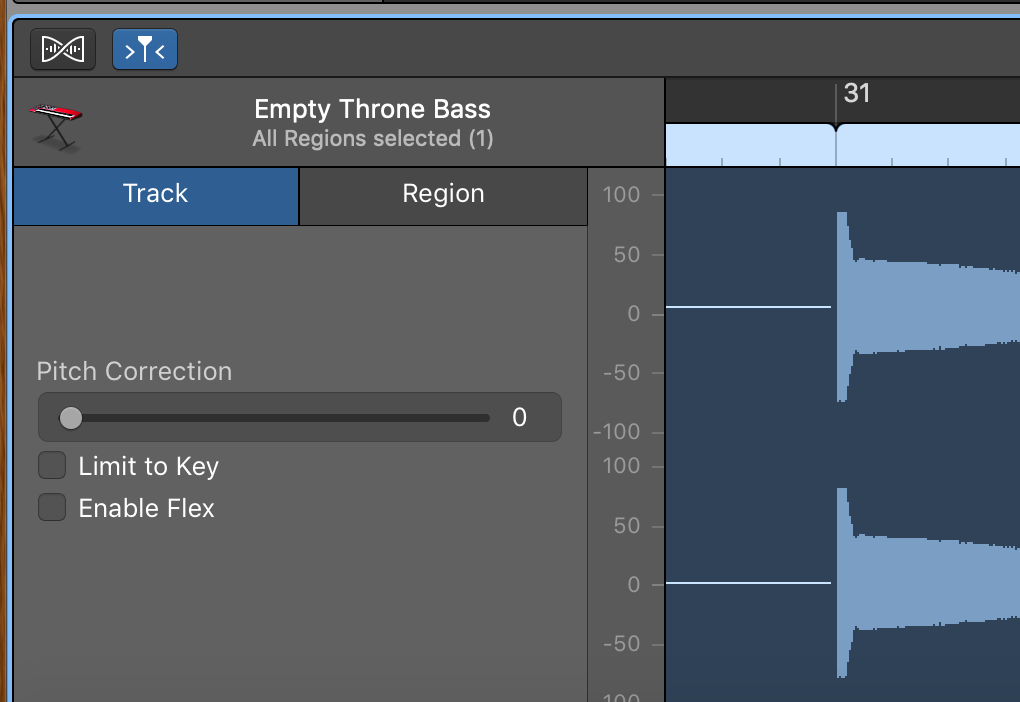
You can drag and drop any loop into your mix and edit its pitch to fit your piece.You can do lots to software instruments that you can’t to real ones. You can use this toggle to change the pitch to fit your piece:

You can access the loop gallery buy clicking the loop button i the top right hand of your screen.

(The centre icon is for Loops)

Creating a Drum Pattern

One of my favourite things about Garageband is that you can access virtual drum kits, that you can play just by clicking on your screen or dragging icons into different places on a virtual pad.

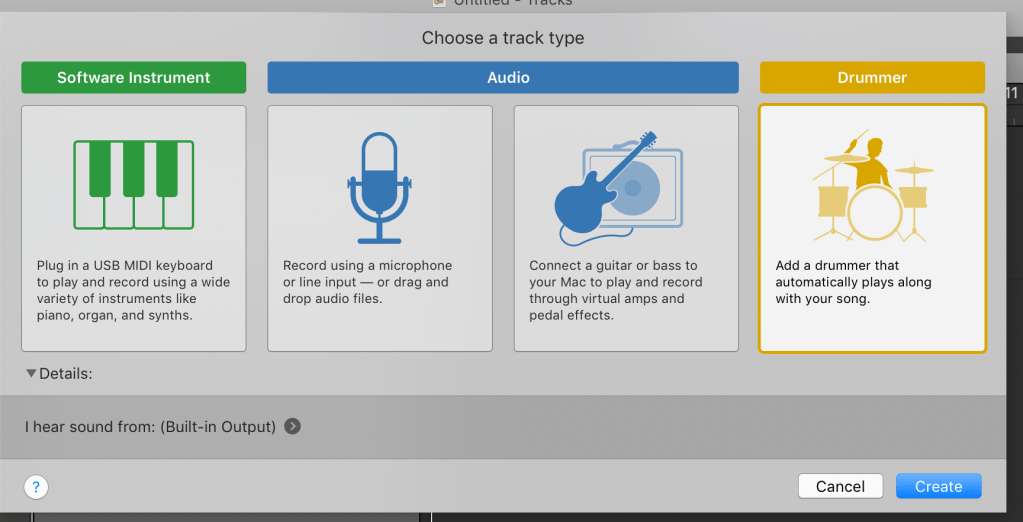
When you add a ‘new track’ these options appear:

Here you also find options to add a MIDI track and Audio Tracks.

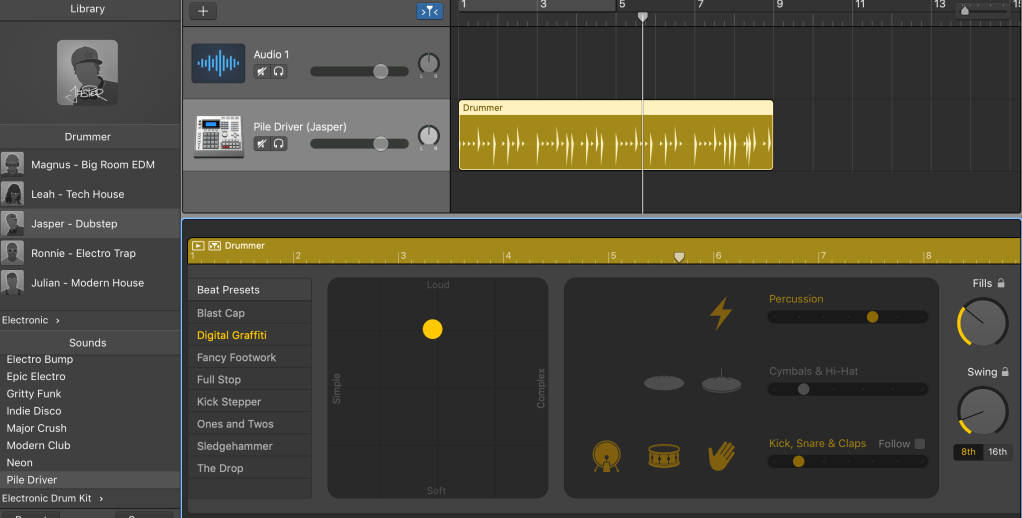
Once you click on ‘drummer’ you have so many options on how to customise your drum sound.

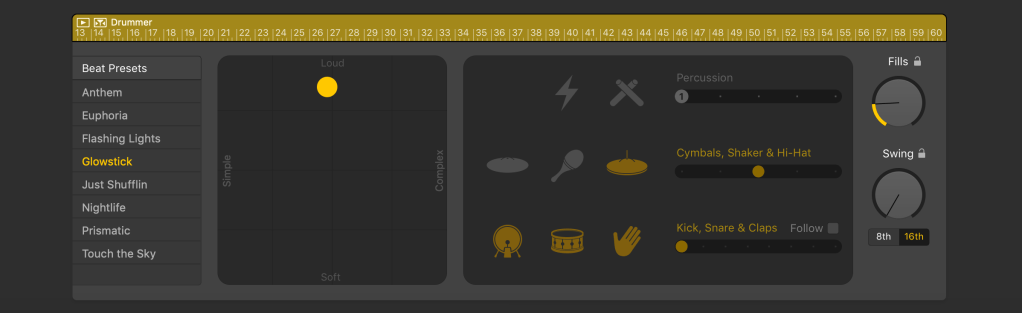
You can click what type of drum sound you want on the left column and the sound in the middle at the bottom. From there you can click what you want included at the bottom right and finally how loud, simple, complex or soft you want it by dragging the yellow circle around the virtual pad.

How I Created ‘I Rise’

To use all the things mention above, I decided to create a piece of music solely in garage band. As I wanted to spend more time on the backing (as I am just as much as a beginner as you guys are here!- That is, if you’re a beginner), I decided to create simple melody and take lyrics from something already written. I chose Maya Angelou’s poem “I Rise.’ (I didn’t sing all verses as some spoke about the struggles of black people as slaves and this would not be appropriate as a white person).

My first step was creating my melody and then recording my vocals. I toggled with the tempo on the metronome by clicking the number and sliding up and down until I found the tempo I was happy with. I chose 85.

I recorded my vocals using a USB Microphone. Much like MIDI keyboards, you can plug a USB mic directly into your laptop or computer.

After recording, I went back and critically listened to it. I found bits where I wasn’t happy with how I sounded, where the rhythm was out and got rid of any annoyingly loud breaths by removing the dead space (the bits between vocal phrases that are recorded but are essentially black)

Next, I used the software drummer software to create the drum beat. Here is my layout.

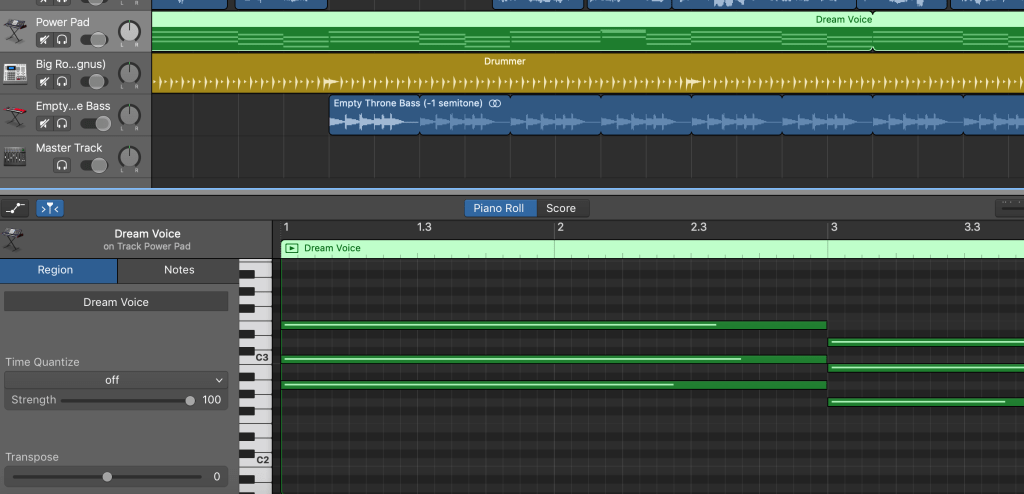
Then it was time to get chordal. I plugged in my MIDI keyboard and chose a synth that fit into the vibe I wanted from the piece. I then played the chord sequence I wanted a couple of times. There was so need to keep playing them as I double clicked and set the loop setting on. The it as easy as just dragging until I was happy with how many I had!

By double clicking on the MIDI track, you can bring up the notes in further detail. It was so easy to just click the end of the notes and drag them to the length that I wanted them to be, or even move them if I clicked the wrong note.

Next I decided to add a bass loop. It took a while to find one I was happy with but once I did I decided it was time to mix.

This icon, which you can find on the top left corner gives you access to EQ, Compression and Echo. Garageband comes with some super cool EQ presets, designed for each instrument. That being said, I used the Male Vocal preset on mine. Its worth trying them all to see what suits you best!

Hint: Double click your vocal line and it comes up with an option to add some some pitch correction! I set mine to 70 as I wanted it to have an electric feel but without sounding too robotic.

It was now time to sort the volume out. Click this icon:

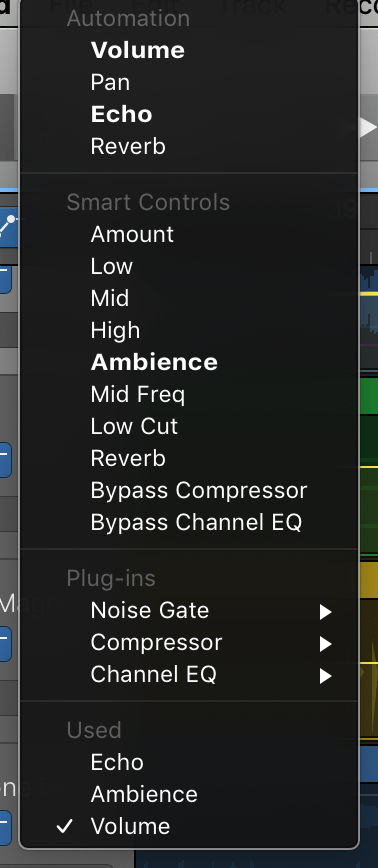
This will open up automation. Automation can be used to control all these things:


I used it to control the levels or volume on all my tracks and the echo on my vocal line.

Here is an image of what it looked like when I edited the echo automation.

Once these steps were all completed it was time to master.

When you click the edit icon to give you access to EQ etc., there is an option to click ‘master’ and apply these plug ins to the whole track. I did this and then adjusted the master volume with the volume slider on the master track.

Then it was done!! Click the link below to have a listen!!

Thanks for Reading!! I hope these tips could be helpful to you in terms of creating your own music!!!

Bridge-ing the Gap

The final piece of our songwriting journey takes us to the bridge (which is also known as the middle 8).

So what is a bridge?

A bridge is a few bars of music that is normally present after the 2nd chorus, before the 3rd (and sometimes 4th). It provides contrast to the rest of the piece and sometimes is intended to change the mood.

It is also a fantastic opportunity for lyricists to show off, creating a section different to the rest of their piece, yet still in fitting with the rest of the song.

Musically, the bridge has a different melody to the verse, chorus and pre-chorus. Despite this, it has the rather difficult job of taking us away and bringing us back to the chorus (as songs don’t end on the bridge). Like a real bridge, it connects the choruses together.

Credits to creator

Having 3 choruses in a row can get a little repetitive, right?

The bridge breaks this up, providing interest and variation, making the song all the more exciting.

Examples of Bridges

Sometimes bridges can be very simple, existing only to break up the repetitiveness of repeating choruses.

Demons- The Wanted

As a teen, I wasn’t a One Direction girl, I was 100% a fan of The Wanted. During lockdown I’ve been reminiscing these times, jamming out to boyband perfection and came across this bridge that is the perfect example of simplicity, yet functionality.

My 14 year old dream boys

Below are the lyrics of the choruses before and after the bridge, with the bridge in bold italics.

All my life, I’ve played like a winner
Now all I see looking back in the mirror
Demons in my head
The demons in my head, oh oh
All this time, the saint was a sinner
The jokes on me, a stone cold killer
Demons in my head
The demons in my head, oh oh

All this time,
I said all these time
All this time
All this time
All this time
All this time
I said all this time
All this time
All this time
All this time

All my life, I’ve played like a winner
Now all I see looking back in the mirror
Demons in my head
The demons in my head, oh oh
All this time, the saint was a sinner
The jokes on me, a stone cold killer
Demons in my head
The demons in my head, oh oh

As you can see, the bridge is essentially 3 words, repeated, a lot. (Ok there’s 5 words but still). But it’s not just that, ‘all this time‘ is present in the chorus. This simple bridge has a different melody but reference the lyrics in the chorus, creating the link between the two.

Summertime Sadness- Lana Del Rey

Queen Lana creates a beautiful bridge in this song, adding an extra layer of emotion to the lyrics.

I got that summertime, summertime sadness
S-s-summertime, summertime sadness
Got that summertime, summertime sadness
Oh, oh, oh, oh, oh

Think I’ll miss you forever
Like the stars miss the sun in the morning sky
Later’s better than never
Even if you’re gone I’m gonna drive (drive, drive)

I got that summertime, summertime sadness
S-s-summertime, summertime sadness
Got that summertime, summertime sadness
Oh, oh, oh, oh, oh

The bridge links the choruses beautifully, with a differing melody that still fits in fantastically.

Her voice becomes higher pitched- more like head voice style, and this created an extra layer of contrast between the bridge and the rest of the song

Do you enjoy writing bridges? Let me know and leave a comment down below!

And hey, thanks!!!

Pre-Chorus Practices

While not every song uses a Pre-Chorus, they are without a doubt a key component in popular song structures.

So What Even Is a Pre-Chorus?

Pre-Choruses (like its name suggests) sits in between the verses and the chorus in your song writing structure. It is often two to four lines long however could even go up to eight at times. It is very unlikely to find one above eight!

Like the chorus and verse, the pre-chorus (usually) has the same melody every time it appears in the song.

Often the lyrics are the same too, however unlike the chorus, some songwriters change the lyrics but keep the melody the same so that it is still identifiable as the pre-chorus.

A few notable examples of using a pre-chorus are as follows:

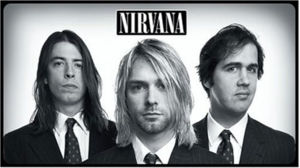
Nirvana- Smells Like Teen Spirit

An Iconic Song by an Iconic (at least in my opinion anyway!)

The Pre-chorus goes as follows:

Hello Hello Hello How Low

Hello Hello Hello How Low

Hello Hello Hello How Low

Hello Hello Hello

Seems pretty simple right? Sometimes simplicity is all you need because this pre-chorus does a great job of getting us (the listeners) excited and pumped up for the chorus we all know is coming.

A great pre-chorus is a bit like a ramp, leading the energy from the lower level of the verse, up to the higher energy level of the chorus. Another fantastic example of using the Pre-Chorus to do this is:

Katy Perry- Firework

Despite the opening two lines (Yes Katy, sometimes we do feel like a plastic bag but we don’t normally word it like that) Firework is a banger! It is a pop song in its purest form. It’s upbeat, fun and happy and its pre-chorus perfectly revs up the listeners, getting them ready to belt out the chorus along with Perry.

You just gotta ignite the light

And let it shine

Just own the night

Like the 4th of July

Cause Baby You’re a FIIIIIIIIREEEWOOOOOORK, Come on, show ’em WHAAAT YOOUR”E WOOORTH

*ahem*

Like I said, the pre-chorus just makes you want to sing along!

A Pre-Chorus adds another layer to the song, varying the simple structure of Verse Chorus Verse Chorus.

If you have more to say with your lyrics, utilising a pre-chorus allows you more room to do so. It also gives the writer an opportunity to create a few bars to help the transition from Verse Melody to Chorus Melody.

Do you have any favourite Pre-Choruses? Comment and let me know!

Creating a Chorus

The Next Step

Now that we’ve spoken about Verses, its time to move onto the next (and arguably most important) part of the song structure- the Chorus!

Almost all genres of songwriting have the use of a chorus in common, from Jazz to Rock and Roll. They are often the most melodically catchy part of the song, the bit that you always want to sing along to.

What makes a Chorus so Catchy?

Choruses almost always have the same melody and the same lyrics. Since a chorus is often repeated at least twice in most common song structures, the repetition helps to get the chorus settled into memory.

One way to make sure your chorus is memorable is to not overcomplicate it. Create 1 or 2 simple Motifs and build from there. It is often the simplest choruses that are the most memorable!

For those who don’t know what a Motif is, Tunecore defines it as ‘A short musical idea that is used to build up phrases, melodies, riffs and grooves.’

Where Should the Chorus Go?

Where do you place a chorus in the song? There are so many options that below are some structures frequently used to help you decide:

  • AABA– This structure is Commonly Used in Jazz Standards. The chorus is sung, then repeated, followed by a verse and then a final chorus with variations.
  • After each Verse- An incredible common place to put Choruses is after each verse, creating an ABABAB type structure
  • At the start and before each verse- the reverse of the above, sometimes starting with the chorus is the way to go
  • After a pre-chorus– Pre-choruses are something we will go into in a future post, but they are usually 2-4 lines that come (as the name suggests) before the chorus!

Using the Chorus to Sing the Title

One of the biggest uses of a chorus, is to bring the title into the lyrics. This adds to the ‘Memorable’ factor of the song as you get the title stuck in your head.

Much like the placing of the chorus, there are a few different places you can place the title. Here are some examples.

  • 1st Line- Often, songs have the title in the first line of the chorus. One such example is Alarm by Anne-Marie
    • The Chorus goes as follows: And there goes the alarm ringing in my head, Like somebody said, “don’t you trust him, no, Texting from his ex, what did you expect? Now you’re lying here knowing where he goes… etc
  • Book Ending– This is where the title is present in the first and last lines, encompassing the chorus like- well- book ends! An example of this is I Am The Fire– by Halestorm
    • The Chorus goes: I am the fire, I am burning brighter, Roaring like a storm, And I am the one I’ve been waiting for, Screaming like a siren, Alive and burning brighter, I am the fire.
  • AABA- In many songs, the title features in the first two lines as well as the last. A well known example of this technique is the song You Raise Me Up
    • Here is the technique in action: You raise me up, so I can stand on mountains, You raise me up to walk on stormy seas, I am strong when I am on your shoulders, You raise me up to more than I can be.
  • Final Line: Many songs save the title for the final line of the chorus, putting emphasis on it to get it really stuck in your head. I Prevail use this technique in their song My Heart I Surrender.
    • Will our stars ever align?, Will two hearts, beat in time? These words you should always remember, To you, my heart I surrender Chasing love that can never be mine Maybe one day you’ll realize These words you should always remember, To you, my heart I surrender.
I Prevail

Using These Techniques

Using everything I’ve learnt above, I am going to write 4 variations of a chorus, each with the title being places in one of the 4 scenarios. As far as lyrics go, I’m sat outside as I write this so I will use that as my inspiration.

The title of the ‘song’ will be Sunshine

Chorus 1: First Line

I see Sunshine through the trees,

Hear the birds and hear the bees,

There are no clouds in the sky,

Nothing but the summer breeze.

Chorus 2: AABA

I see Sunshine in the Sky,

I’ve Got Sunshine in my Eyes,

Even on the cloudy days,

There’s Sunshine when you’re with me.

Chorus 3: Book Ending

I see Sunshine through the trees,

Hear the birds and hear the bees,

Nothing but the summer breeze,

I see Sunshine through the trees.

Chorus 4: Final Line

The sky’s always blue,

Because you are mine,

There’s no clouds in sight

‘Cause you’re my Sunshine.

Whist slightly basic (and a tag cringey) the 4 choruses above showcase how to use the title techniques.

Try them out when you’re next writing lyrics and see which one works to make your song the most memorable.

Thanks for reading everyone, happy songwriting!

Artemis x

What is a Verse?

Sounds like Songwriting 101 right?

But when you think about it, what actually is a verse?

What does it do?

What is its purpose?

Sure we all know that a verse is a piece of music that goes before and after a chorus (or is it?), is the same each time (or is it?) and doesn’t really matter as much as the chorus (or does it?!).

(Image from Pixabay)

What does the Verse actually do?

Songwriting is not an exact science so verses do not always provide the same thing to each song, but in a lot of songs the verses provide the exposition. Jason Blume (writer of the book ‘6 Steps to Songwriting Success’) describes the content of verses as ‘the information that will lead to the song’s hook or title.’

Essentially, its story time! A catchy verse without context is just a set of words. What the verse can do is provide this context, set the emotion/tone and put your storyline into the song.

Hallelujah! for Storytelling

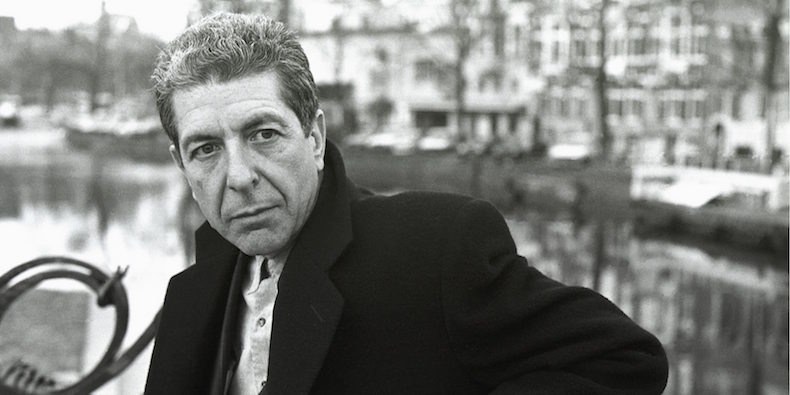
One example of a song that utilises the story telling capabilities of verses beautifully is Leonard Cohen’s ‘Hallelujah’.

Leonard Cohen

I guarantee you’d be hard-pressed to find someone who didn’t know the chorus of Hallelujah. It’s essentially just the word repeated 4 or 8 times (albeit beautifully!).

The word Hallelujah is a Hebrew word meaning ‘Praise be to God‘ and Jewish songwriter Cohen translated this into his work by referencing stories from the Torah throughout.

This can be seen in the first verse which is arguably the most well known.

Well I’ve heard there was a secret chord,
That David played and it pleased the Lord,
But you don’t really care for music, do you?
Well it goes like this:
The fourth, the fifth, the minor fall and the major lift,
The baffled king composing Hallelujah
.

King David of the Jewish people (fun fact: my school was names after him!) cleansed King Saul of evil with his spiritual musicianship on the harp. You can see the references here in lines such as ‘that David played and it pleased the Lord’, which refers to this act.

And it came to pass, when the evil spirit from God was upon Saul, that David took a harp, and played with his hand: so Saul was refreshed, and was well, and the evil spirit departed from him” – 1 Samuel 16:23

Cohen also references moments like Delilah cutting Samson’s hair and robbing him of this powers (She tied you to the kitchen chair, and she broke your throne and she cut your hair) and David seeing Batsheva for the first time (You saw her bathing on the roof.)

Verse Structure

Whilst verses tend to have the most melodic and lyrical variation of a song, there are a lot of common structures that a lot of songwriters often use.

Here are a few key rules that most (but not all) verses follow:

  • Verses all have the same melody each time
  • Often 8-16 bars long
  • Often consist of 4-8 lines of lyrics
  • New lyrics per verse
  • Same chord progression as previous verses
  • Lyric lines have emphasis in the same parts as the other verses

(Most Pop songs that you hear on the radio follow these rules but other genres, such as Jazz, can be more fluid with their song structures.)

As well as the points above, many verses follow either an AABA (e.g. Dance Monkey- Tones and I) or ABABCB (e.g. Sorry Not Sorry- Demi Lovato) structure.

The Importance of the Verse

(Image from Pixabay)

When you listen to a song, it is very likely that the first verse is the first thing you hear.

That means it has got the be engaging or any listeners could very easily click next.

Some methods to try out to make your verses more interesting are:

Vary your rhythms: Take influence from things like Iambic Pentameter in Poetry or try to Sing as you speak, not adapting the stressed syllables of sentences to fit a line.

Change up your structure: Maybe give AABCA or ABCBC a try?

Use external influences: Like Cohen did with stories from the Torah, mix it up a bit and write verses inspired by things you normally wouldn’t write about!

Giving it a go!

Since the aim of this project is for me to become a better songwriter, I thought I would take a page out of good ol’ Leonard’s book and write a verse that could fit into the Hallelujah structure.

This means I will:

  • Keep the rhythm the same as the other verses
  • Have the same number of lines
  • Stick to the same melody (please imagine it! Sadly I can’t come into your home and sing it to you :P)
  • Take inspiration from a story of the Torah (I’ll choose Noah’s Ark)

So here is what I came up with!

And so they came in two by two,

So less would be destroyed by you,

Your hand casting a shadow few can live in,

And while the waters fall around,

Your anger doth destroy the ground,

And from the sea they all cry Hallelujah!

Thank you for reading! Tune in for the next post where we will be breaking down the chorus.

If you enjoyed reading this or have anything to share, drop a comment down below!

Charlotte x

Popular Songwriting Themes

Struggling to think of ideas for your next song?

When you’re listening to the radio, you start to notice that a lot of songs seems to have the same themes. Why not use one of these themes to write your own?

I have scoured the internet (as well as listening to hours and hours of music, ya know ;P) and compiled a list of the most used themes used songwriting. Take a look below!

Love

Without a doubt, love is one of the most popular themes in writing songs. Love songs come in all shapes and forms, whether it is lamenting love for someone, describing the feeling itself or creating a first dance-type song.

Some popular love songs include:

  • How Deep is Your Love– the Bee Gees
  • The Power of Love– Jennifer Rush (other versions include covers by Celine Dion, Gabrielle Aplin and Dalton Harris)
  • Perfect– Ed Sheeran
  • I Will Always Love You– Whitney Houston
  • We Found Love– Rihanna and Calvin Harris

Heartbreak

Losing love can be just as much of an inspiration for songwriters as love itself. Heartbreak can move people to creativity in all manners of ways and here are some examples of famous heartbreak songs.

  • You Can Go Your Own Way– Fleetwood Mac
  • Rolling in the Deep– Adele
  • The Winner Takes it All– Abba
  • Dancing On My Own– Robyn
  • Un-break my Heart– Toni Braxton

Sex

Lets talk about sexy baby, lets talk about you and me 😉

In a world that is becoming increasingly more sex-positive, lots of music turns to S. E. X. Whether the song is a beautiful description of two bodies coming together or just a raunchy 3.5 minutes of beats and butts, more and more music nowadays is talking about sex.

Looking for a bit of sexpiration?

  • Lets Get it On– Martin Gaye
  • Feelin’ Myself– Beyoncé and Nicki Minaj
  • 2 Become 1– Spice Girls
  • I’ll Make Love to You– Boys II Men
  • Pony– Ginuwine

Partying

These tunes normally have a heavy focus on the beat and want to get you in the mood to dance! Party songs can turn any night from boring to banging.

  • Party Rock Anthem– LMFAO
  • Lets Get It Started– Black Eyed Peas
  • Party in the USA– Miley Cyrus
  • Fight for Your Right (to Party)– Beasite Boys
  • Girls Just Wanna Have Fun– Cyndi Lauper

Politics

Musicians have often used their medium to draw attention to- what they believe to be- political injustices. From wars to racism, songs can challenge the political landscape and bring issues into the public eye.

Some classic examples of songs with a political message are:

  • Born in the USA– Bruce Springsteen
  • American Idiot– Green Day
  • Revolution– The Beatles
  • Blowin’ in the Wind– Bob Dylan
  • Uprising of Love– Melissa Etheridge

The Body


Curves, eyes, butts and thighs, singing about the body- especially the female body- is a common theme in a lot of popular music. Whilst there is an argument that it can often be quite objectifying in certain ways, there has been a huge surge in body positivity songs over the past few years.

Check out some examples below:

  • Anaconda– Nicki Minaj
  • My Humps– Black Eyed Peas
  • Whole Lotta Rosie– AC/DC
  • Video– India Arie
  • My Skin– Lizzo

If you turn the radio on, chances are you’ll hear a song about one of these 6 topics.

What do you think? Are these the themes you normally use when you write the songs?

Artemis x

Shape of You

Writing The Top Song of the Decade

2020 New Year has been and gone (here’s to finally making it past January!) and with it, we welcome in a new decade.

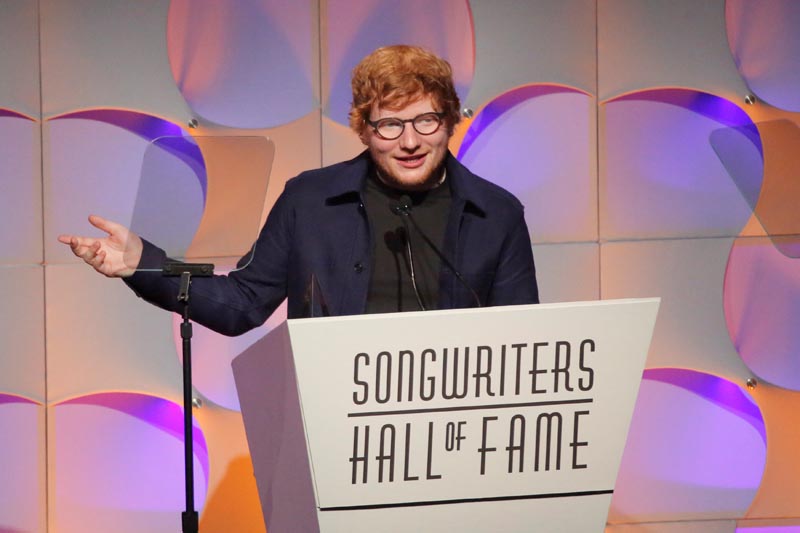
Without a doubt, one of the most successful popular musicians of the past year was Ed Sheeran. From his third studio album Divide, Shape of You, won the top spot of the 2010’s.

Ed Sheeran as a Songwriter

Unlike a lot of mainstream singers nowadays, Sheeran is known for writing his own music. What many people don’t know, is that a lot of your favourite songs from other artists might have been written by him too.

Die-Hard fans of Justin Bieber would know that Love Yourself was written by Sheeran and even One Direction’s Little Things came from him.

If you check the wikipedia page on this (I know I know… not always the most accurate but…), including his own songs, Sheeran is said to have written around 102 songs.

Safe to say the man knows what he’s doing.

So, how do you write the decade’s top song?

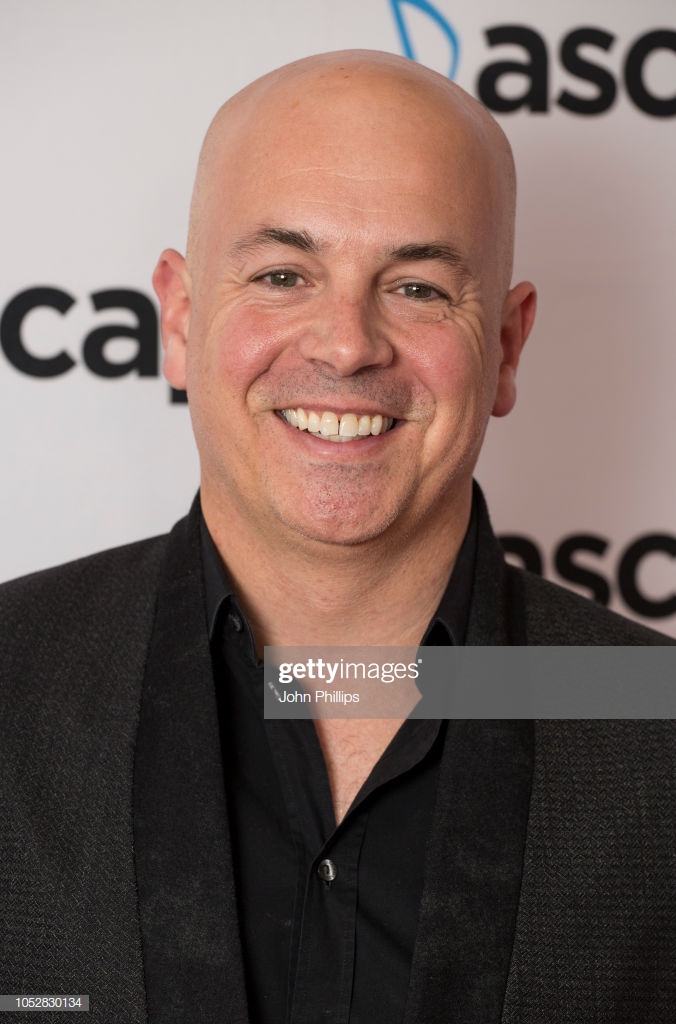
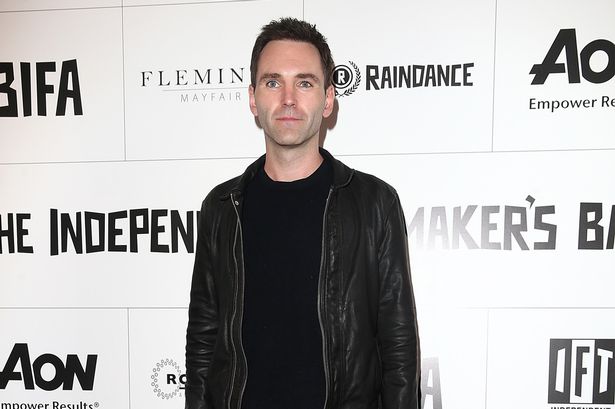
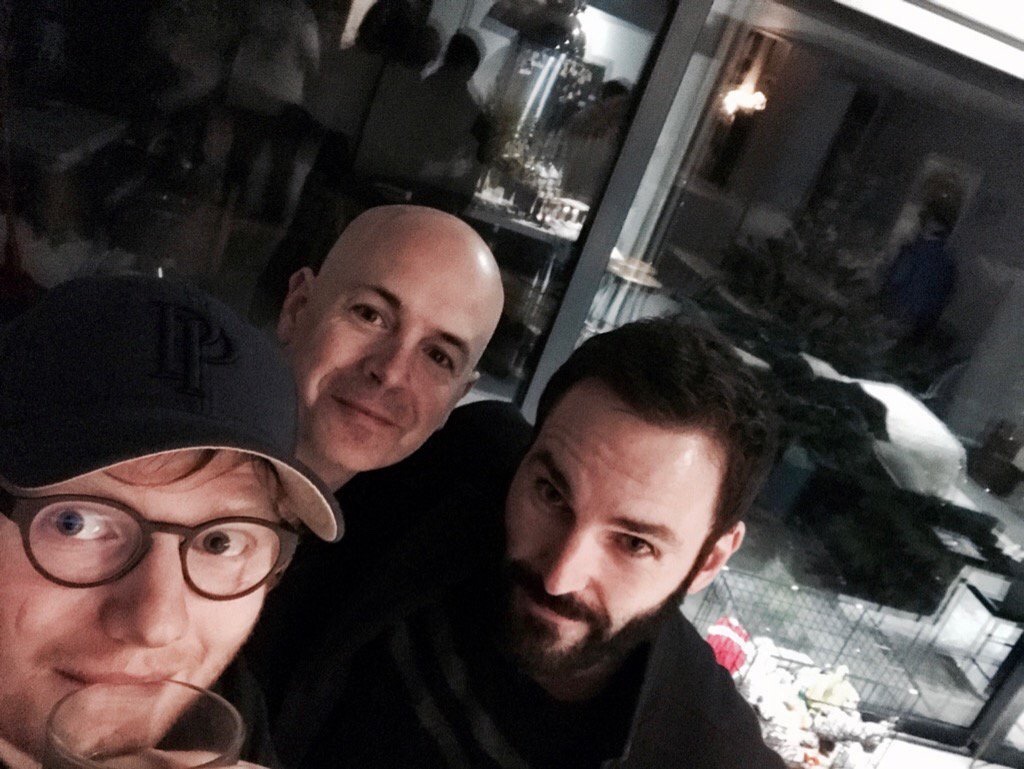
Not alone apparently! Sheeran wrote Shape of You with the help of Johnny McDaid (the British hitmaker behind Flying Without Wings) and Steve Mac (member of Snow Patrol).

Like a lot of current pop hits, ‘Shape of You was written in a brainstorming session where ideas are developed or disregarded fast, with computers and instruments close at hand with recorders running.’

The first bit of the piece was the keyboard riff by Mac. He played it ‘with the log-drum sound that happened to be his synthesizer at the time’ creating a Caribbean-esque rhythm which was quite popular then. It was only then that Sheeran started creating ideas for a melody. The melody started out without lyrics.

(Personally, I find this rather strange as I always create my lyrics and melody at the same time. Theres a technique to try in the future!)

To create percussion, Sheeran would tap, slap and strum on his guitar with the strings damped.

Mac described Sheeran’s technique as: ‘He’s doing one part, he does the next part, he does the next part and puts those on top of each other.’

(Fun fact: Once they realised the song sounded similar to No Scrubs- negotiations were made to give the writers Kandi Burruss, Tameka Cottle and Kevin Briggs songwriting credits!)

To create contrast, the song uses dynamics, lyrics and rhythm changes as opposed to key changes.

When it comes down to the lyrics, inspiration was drawn for a variety of places. Sheeran was inspired by people he knew who were in relationships who met in pubs and the idea of taking a plastic bag into a Chinese buffet was inspired by Fresh Meat.

The titular line doesn’t actually mean what you might think it means. McDaid suggested ‘Shape of You’ because in Northern Ireland, where he’s from, the phrase has a beautiful meaning.

Whatever you are, whatever it is, I’m in love with you. It is the shape of who you are figuratively.

When I first heard the song, I figured it was talking purely about physical appearance. On the contrary, it was put in the song (due to its deeper meaning) to counteract the objectifying ‘I’m in love with your body.’

Some interesting song writing tips were in the New York times article along with the process. To quote the article:

If there’s only a vocal and one sound, that’s going to sound much louder on radio than if you have a hundred sounds… If the lyric’s good enough, and the melody’s crazy, and you’ve got one sound showing where its going to go, you don’t need much more than that’

The songwriting tip that I personally found the most useful was to be careful to keep the song uncluttered.

So there you have it!

The songwriting process behind the most popular song of the 2010’s started in a brainstorming session, combining the idea of three incredible musical minds.

What do you think about the song? I would love to hear what you thought!

Artemis

If anybody want to read the NY times article, you can find it below.

Design a site like this with WordPress.com
Get started